
“If I’m going to get by in pictures, it’s going to be as a singer, with about as much acting as you would expect from a guy standing in front of a microphone.” –Bing Crosby
Bing, or Harry Lillis Crosby Jr., was the fourth of seven children born to brewery bookkeeper Harry Lillis Crosby Sr. and his wife, Catherine, in 1903. The family lived in a home their father built at 1112 North J. Street in Tacoma, Washington. However, the family moved from Tacoma to Spokane in 1906, which is where Harry Jr. was primarily raised.


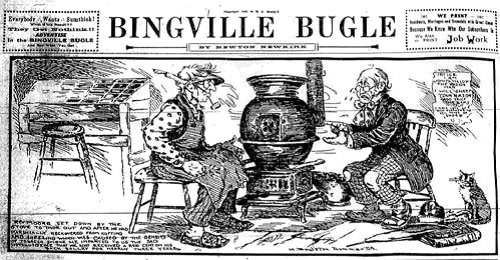
In 1910, a six-year-old Harry was forever renamed. Each Sunday morning, the Spokesman-Review published a comic entitled, “The Bingville Bugle.” The comic strip was a faux hillbilly newsletter with gossipy tidbits, minstrel quips, creative spelling, and mock ads. Little Harry would dash down the street to his close friend and neighbor, 15-year-old Valentine Hobart, who also shared an enthusiasm for the comic. Harry would shout, “Bing! Bing! Bing!” and ask Valentine to read the comic strip to him. Valentine started to call Harry “Bingo from Bingville,” but the nickname was shortened to “Bing,” and adopted by his friends and teachers.
In 1917, Bing took a summer job as a property boy at Spokane’s “Auditorium,” where he witnessed some of the finest acts of the day. While Crosby graduated from Gonzaga High School in 1920 and enrolled in Gonzaga University’s law program, thereafter, he did not complete his Bachelor’s degree. Instead, Crosby became more interested in playing drums and singing with the local band. The group was largely comprised of high school students a few years younger than himself. They dubbed themselves the Musicaladers and performed at dances for high school students and clubgoers. The group also performed on the Spokane-based KHQ radio station but disbanded after two years.


By 1925, Crosby had formed a vocal duo with partner Al Rinker, brother of singer Mildred Bailey. Bailey introduced Rinker and Crosby to Paul Whiteman, who was at that time America’s most famous bandleader. Hired for $150 a week in 1926, they made their debut on December 6 at the Tivoli Theatre in Chicago. Their first recording was “I’ve Got The Girl,” with Don Clark’s Orchestra, but the Columbia-issued record did them no vocal favors, as it was inadvertently recorded at a speed slower than it should have been, which increased the singers’ pitch when played at 78 rpm. Throughout his career, Crosby often credited Mildred Bailey for getting him his first important job in the entertainment business.
Even as the Crosby and Rinker duo was increasing in popularity, Whiteman added a third member to the group. The threesome, now including pianist and aspiring songwriter Harry Barris, was dubbed “The Rhythm Boys.” They joined the Whiteman touring act, performing and recording with musicians Bix Beiderbecke, Jack Teagarden, Tommy Dorsey, Jimmy Dorsey, Eddie Lang, and Hoagy Carmichael, also appearing together in a Whiteman movie.


Crosby soon became the star attraction of the Rhythm Boys, and, in 1928, he had his first number-one hit with the Whiteman orchestra, a jazz-influenced rendition of “Ol’ Man River.” However, Crosby’s reported taste for alcohol and his growing dissatisfaction with Whiteman led to his quitting the Rhythm Boys to join the Gus Arnheim Orchestra. During his time with Arnheim, the other two Rhythm Boys were increasingly pushed to the background as the emphasis was on Crosby. Harry Barris wrote several of Crosby’s subsequent hits including “At Your Command,” “I Surrender Dear,” and “Wrap Your Troubles In Dreams.” The members of the band had a falling out and split, setting the stage for Crosby’s solo career.
As the 1930s unfolded, Crosby became one of the leading singers in America. Ten of the top 50 songs for 1931 featured Crosby, either solo or with others. A so-called “Battle of the Baritones” with singing star Russ Columbo proved short-lived, replaced with the slogan “Bing Was King.” Crosby played the lead in a series of sound-era musical comedy short films for Mack Sennett, signed with Paramount, and starred in his first full-length feature, 1932’s The Big Broadcast, the first of 55 films in which he received top billing. Unfortunately, studio heads had issues with his appearance–namely with his ears. In his earlier films, Bing’s ears were actually taped back, much to his annoyance. However, when he proved to become more of a box office draw, he refused to continue this embarrassing practice. He would appear in 79 films and signed a long-term deal with Jack Kapp’s new record company Decca in late 1934.
Crosby starred with Bob Hope and actress Dorothy Lamour in seven Road to musical comedies between 1940 and 1962, cementing the two entertainers as an on-and-off duo, despite never officially declaring themselves a “team” in the sense that Laurel and Hardy or Dean Martin and Jerry Lewis were teams. The series consists of Road to Singapore (1940), Road to Zanzibar (1941), Road to Morocco (1942), Road to Utopia (1946), Road to Rio (1947), Road to Bali (1952), and The Road to Hong Kong (1962). Appearing solo, Crosby and Hope frequently made note of one another during their various appearances, typically in a comically insulting fashion, and they appeared together countless times on stage, radio, and television over the decades as well as cameos in several additional films.
The biggest hit song of Crosby’s career was arguably his recording of Irving Berlin’s “White Christmas,” which he first introduced on a Christmas Day radio broadcast in 1941. The song then appeared soon after in his 1942 movie, Holiday Inn. Crosby’s recording hit the charts on October 3, 1942, and rose to No. 1 on October 31, where it stayed for 11 weeks. A holiday perennial, the song was repeatedly re-released by Decca, charting another 16 times. It topped the charts again in 1945 and for the third time in January 1947. The song remains the best-selling single of all time. Crosby’s recording was so popular that he was obliged to re-record it in 1947 using the same musicians and backup singers; the original 1942 master had become damaged due to its frequent use in pressing additional singles. Though the two versions are very similar, it is the 1947 recording that is most familiar today. Crosby was dismissive of his role in the song’s success, saying,” a jackdaw with a cleft palate could have sung it successfully.”
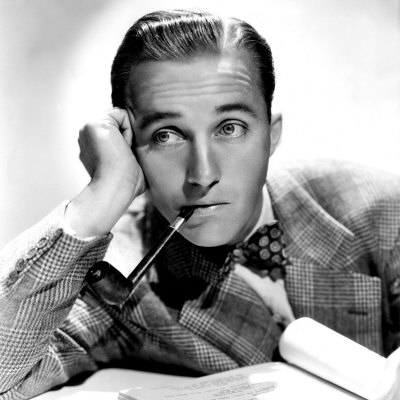
Bing’s onscreen persona exuded an easygoing charm that largely characterized his overall image. Whether he was smoking a pipe, betting on horses, or poking fun at Bob Hope, Bing seemed to possess an air of contentment. His own death came in a moment of leisure—playing a game of golf in Spain.
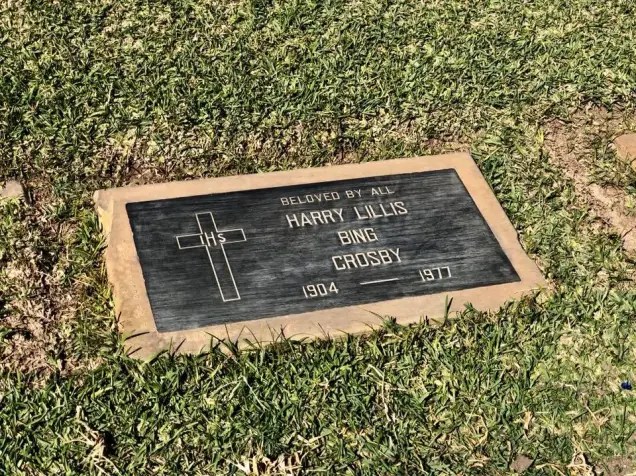
Crosby is at rest at Holy Cross Cemetery, Culver City, California.
Despite being a person who had traveled all over the world to entertain troops, promote films, or even feign exotic travels in “Road to” films, Bing is especially remembered in his home state of Washington. I was lucky enough to present some research in Vancouver, WA, but certainly made a point of it to indulge my film interests and scout out some locations that would have been linked to Bing.
Tacoma is a beautiful town with a deep sense of solace to it. The first home Bing knew still stands at the top of the hill and is marked with a plaque. It is privately owned.
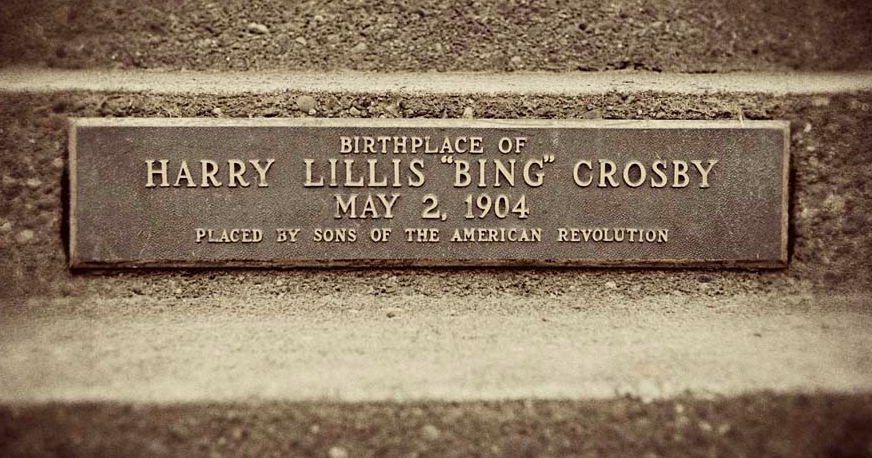
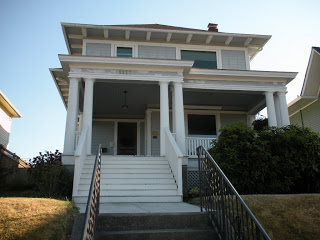
Spokane, however, houses a great deal of Bing-related history, with particular thanks to Gonzaga University. Bing’s childhood home still stands at 508 E. Sharp Avenue.
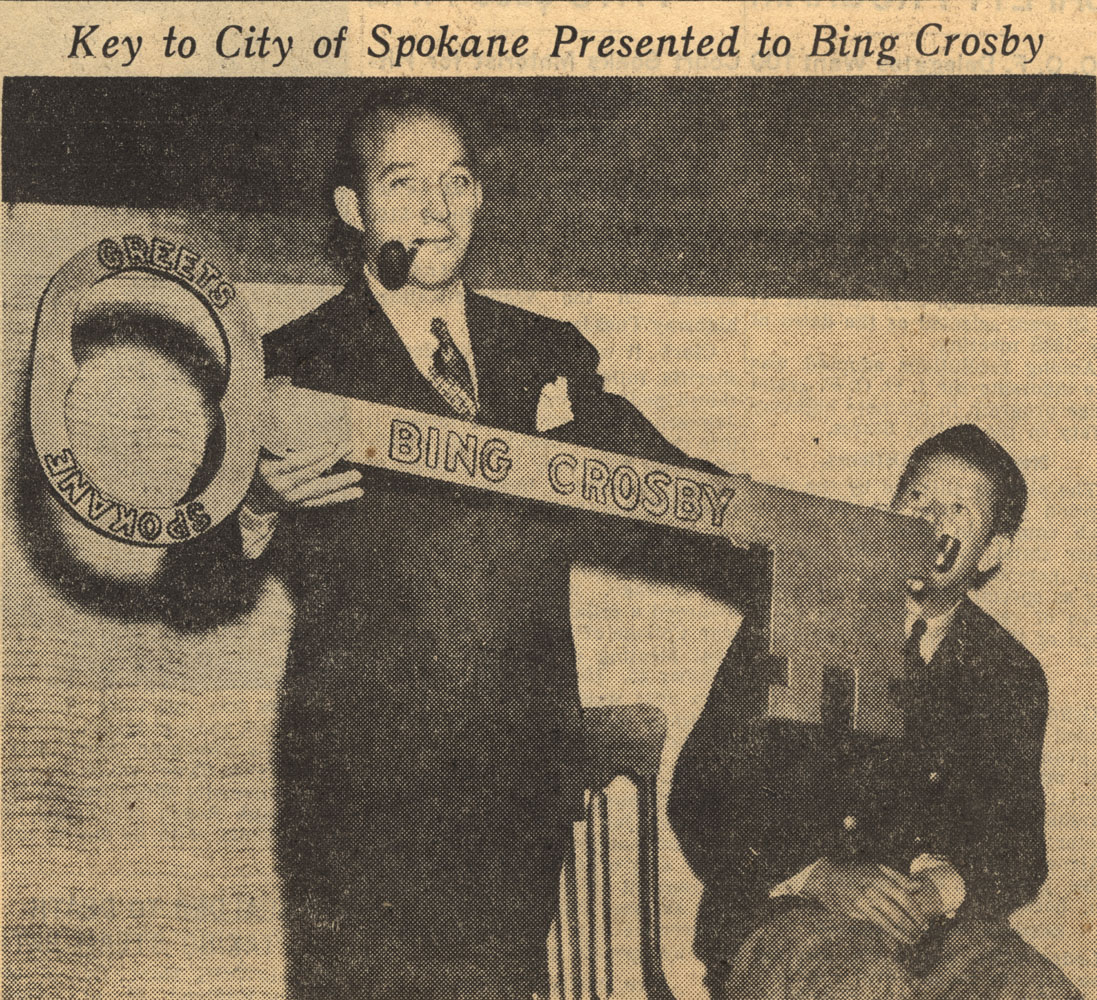
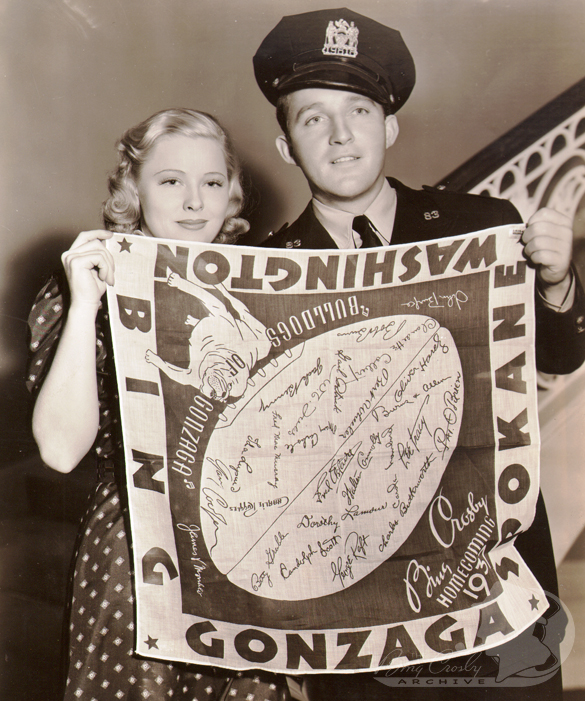
The house served as the Crosby family’s home for 23 years, including when Bing attended Gonzaga High School and Gonzaga University (1914-24). The C. P. Higgins family purchased the home from the Crosby family in 1936 for $3,600 and owned it until 1978. The Gonzaga Alumni Association purchased the house in 1980 and used it for alumni events with staff offices upstairs until 2010 when the Alumni Association moved to the Heutter Mansion across the street. The Crosby House is now used as office space for a couple of university departments. The home celebrated its 100th anniversary in October 2013 with an open house party for the public.


Gonzaga University also has an annual Bing Crosby Film Festival. It’s also not atypical to catch the university’s a cappella group, The Big Bing Theory, serenading some onlookers with a certain Berlin tune.
All the more exciting is the Crosby collection housed at Gonzaga. They have an extensive collection of original manuscripts, records, trophies, plaques, music, photographs, and so much more. The vast majority of these items were donated by Bing himself. The university’s website offers a wonderful virtual tour of the collection. If you are interested in viewing the collection, please be mindful of the building’s hours.
Four years after Bing’s passing, the town dedicated a statue to Bing Crosby on the grounds of Gonzaga’s campus. Crosby’s widow, Kathryn, was in attendance for the dedication, and Bob Hope also took part in the ceremony via phone, being telecast over a loudspeaker. The statue is situated outside the Crosby Student Center and portrays Bing in his familiar hat, with a golf bag and clubs at his feet. The statue will also occasionally feature him smoking a pipe. However, the pipe is now used only for special events, because pranksters like to steal it. Now the pipe can be unscrewed for safe-keeping and re-attached when needed.


Bing remembered Spokane as his hometown, and he had deep ties with his alma mater, from which he received an honorary doctorate. During his life, and after his death, Crosby donated over a million dollars to Gonzaga and Gonzaga High School. Bing had a deep appreciation for the education he received, and the faculty he had the opportunity to meet at Gonzaga.
In the mid-1950s, Gonzaga needed a library building, and Bing was a major financial supporter. He contributed to the library building campaign by organizing a television show and giving the production rights to Gonzaga to secure funds for the library. The show, starring Crosby, Frank Sinatra, Louis Armstrong, Bob Hope, and Rosemary Clooney, was sponsored by the Ford Motor Company to introduce its new “car of the future.” The Bing Crosby Edsel Show aired on CBS on October 13, 1957, and received an Emmy Award. Although sponsored by the Ford Company, Crosby was able to remind his nationwide audience that he was a “Gonzaga man” through some skits.
He raised $700,000 for the library, dedicating it with the following words: “If I am any kind of a success here or in show business, it is the result of the time I spent at Gonzaga in the elocution, the debating, and the dramatic societies…If I am a good Catholic, and I hope I am, it is directly attributable to the influence of the good priests here; and if I am successful, it is because of what I learned here…I am tremendously grateful and I love this school and the people here.”
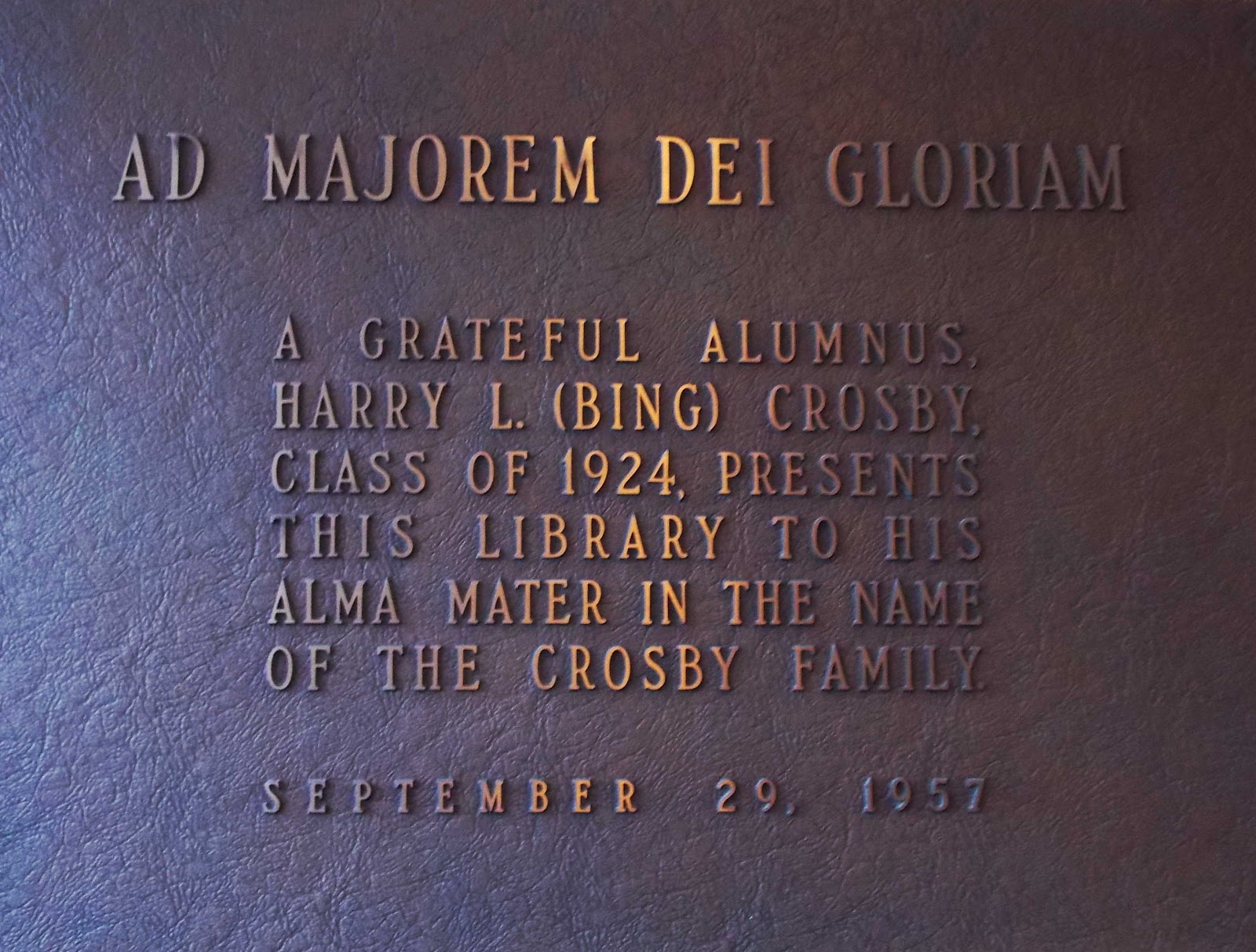
The library was later redesigned as the Crosby Student Center, as a need for more space and technology was met with a new building decades later.
In his younger years, Bing played with the Musicaladers throughout the Spokane area. One theater, in particular, was renamed the Bing Crosby Theater, in honor of Spokane’s homegrown hero.


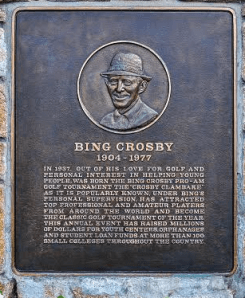
Pebble Beach, California, honors Crosby for the Bing Crosby Pro-Am Golf Tournament. The tournament raised millions for youth centers, orphanages, and college loan funds.
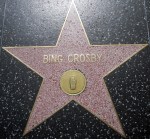
Crosby has three stars on the Hollywood Walk of Fame, honoring his work in recording, motion pictures, and radio. The stars are located at 6751 Hollywood Blvd.; 1611 Vine St.; and 6769 Hollywood Blvd., Los Angeles, California, respectively.
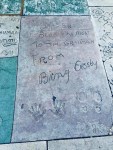
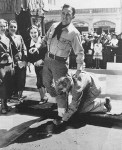
Crosby’s handprints and footprints can be located in the TCL Chinese Theatre forecourt.
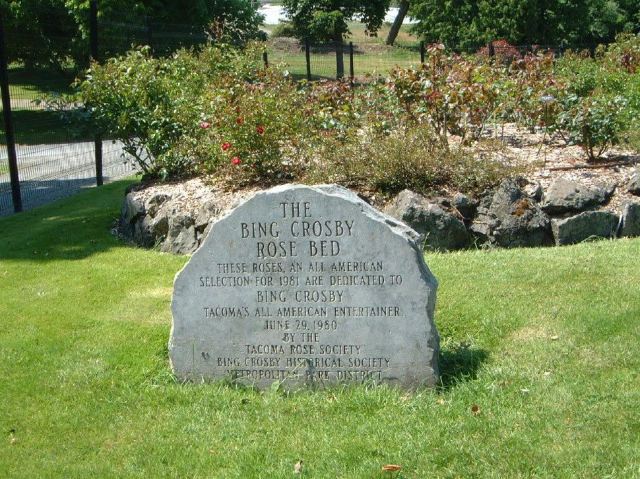
The Bing Crosby Rose is a hybrid tea rose that is named after the famous singer. There is also a rose garden in Point Defiance Park, Tacoma, Washington, that has a Bing Crosby rose.
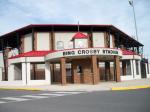
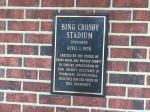
Bing Crosby Stadium is located at 200 E, 8th St, Front Royal, Virginia. In 1949, Crosby made a personal donation of $1,000 toward the stadium project. On April 1, 1950, the town held “Bing Crosby Day.”
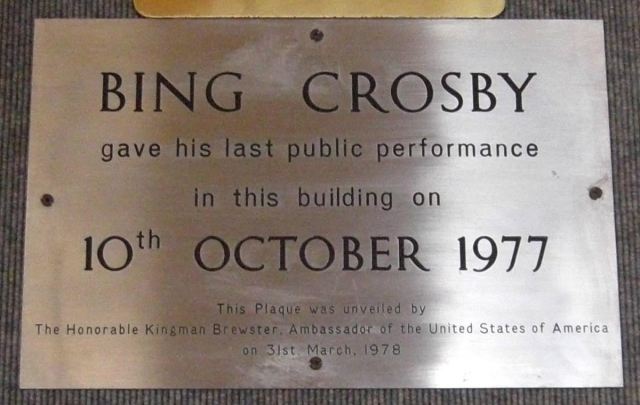
Crosby gave his last public performance at the Brighton Centre on October 10, 1977. There is a plaque commemorating this event in the building’s foyer. The Brighton Centre is located at Kings Rd, Brighton and Hove, Brighton BN1 2GR, United Kingdom.





 Hometowns to Hollywood